Hello everyone,
the INFRASTAR project is done.
After three years of my participation as ESR (Early Stage Researcher), my contract has officially ended on January 1st... but not my PhD.
Since, unlike at most of the universities in Europe, doctoral studies takes usually around four years in ETH domain universities, thus ETHZ and EPFL, I still have couple of months, and plenty of work, to go. My goal is to defend by end of 2020, but it's a material for another post.
Here, I wanted to sum-up a bit the INFRASTAR project from my perspective. It's a good moment, as two weeks ago, on February 6, we have had the final workshop of our project in the capital of EU.
INFRASTAR, as every ITN project, means travelling. With kick-off meeting in Berlin back in 2016; three training weeks in Berlin, Lausanne and Aalborg; Spring School in Nantes; three implementation days in Cologne, Paris and Copenhagen; final meeting in Brussels and, finally, secondments in Aalborg and Paris... I have spent more than half a year out of Lausanne during last three years! All these trips resulted in new contacts, insights and ideas.
The project meant also cooperation. With Mariia and Antoine we've managed to prepare common papers, but I've had a chance to exchange thoughts and ideas with most of fellows. And, I've had an unique opportunity to meet professors and experts who have mastered their domains.
However, the crucial part of the project is feeling that you're not alone. You are not locked in the bubble of your own research. Contrary, you can see work, struggles and successes of the others. This helps a lot, especially during downs, which happen to everyone during the PhD.
Doing PhD within the ITN project is really fortunate, and I am genuinely happy that I could have been part of it. I can't even imagine how the last three years would have looked like without it.
But, now I am in a very short 2020 year. I'm counting days because each one shall be important this year...
Wish me luck!
Friday, 21 February 2020
Saturday, 19 October 2019
Paris, Normandy, Montpellier, Millau... and Lausanne!
Hello everyone,
after three months, my secondment in Paris is done. Thus, it's time for a summary of this interesting period.
During my stay at EIFFAGE I was working on use of BSI® (market name for UHPFRC they have developed) in the bridge structures. It was a great chance to refresh my design skills, learn how this big company works... and try to challenge them a bit ;).
It was also period of verification of my linguistic skills. At EPFL we use mainly English, especially between PhDs. Thus, I have used my stay in France to check whether my French is good enough to live and work there... and it is! It gave me also fresh motivation to continue my language courses.
But, life is not only work, and life of engineer is not only design. While in France, I have had chance to travel a bit and visit couple of interesting bridge structures.
The first one is Pont de Normandie, longest cable-stayed span for some years. It's monumental, and the dumping system for cables reminds that we need to always think three steps ahead ;)
Sorry for the quality of photo, but to get this monster at one picture I had to step back quite far ;)
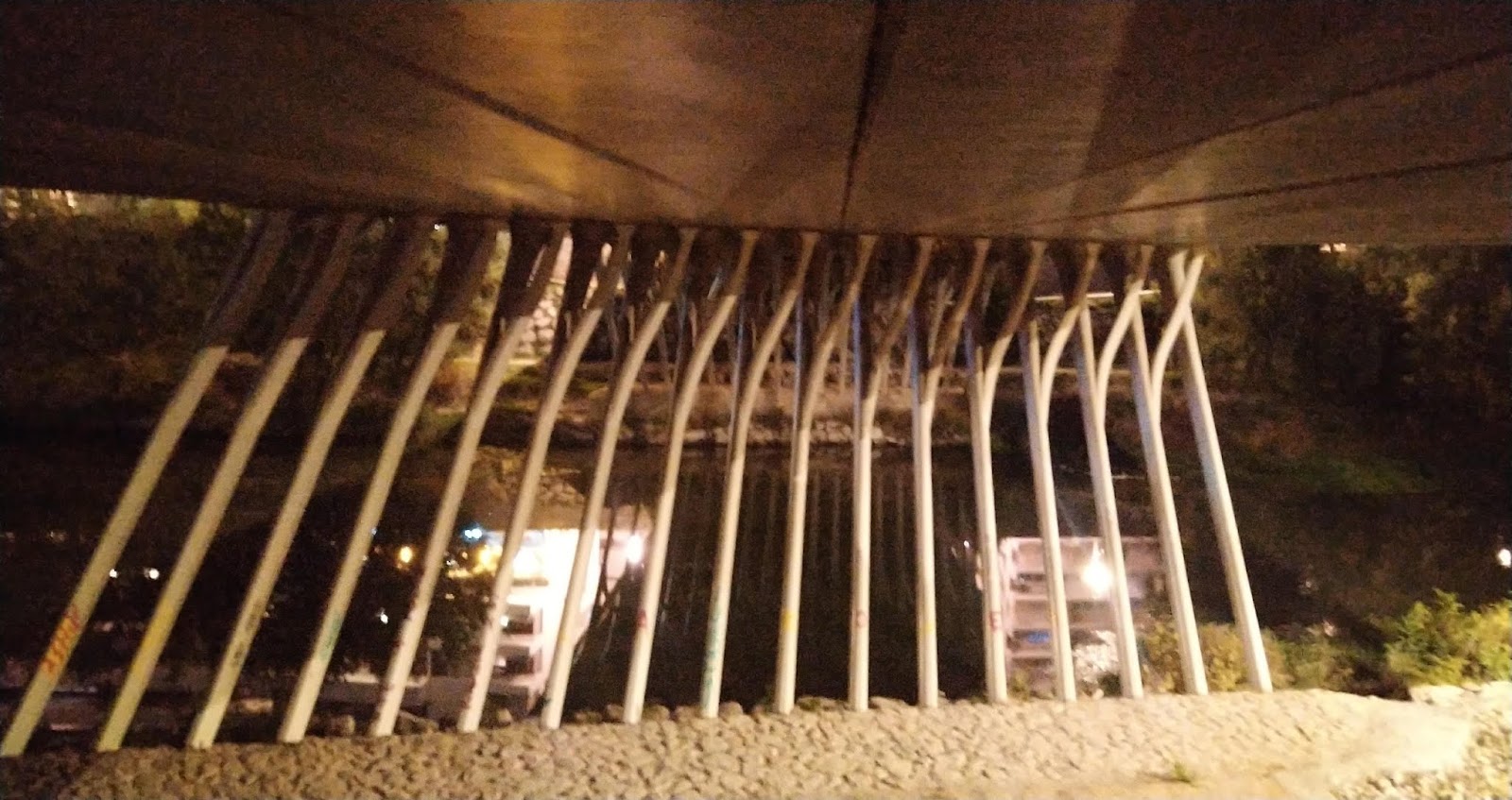
Another structure, interesting from architectural point of view, is bridge in Montpellier. These slender and organic-like piers were possible thanks to BSI®
And finally, a cherry on top, the magnificent Millau viaduct. After reading so much about it, finally I have had chance not only to see it... but to visit it! Guys from EIFFAGE were so nice to show us (Mariia, Antoine and myself) everything, describe how the maintenance and its planning takes place... We could enter and touch whatever we wanted, from the safety surveillance center, through the deck up to the top of the pylon! And, importantly, that's not 'any' bridge, but the tallest one in the world! Take a look at its beautifully curved line on the photo below. No, it was not taken from the drone ;)
Now, charged with good energy I am back in Lausanne. I really liked Paris and work at EIFFAGE, but guess it's true what they say:
We can’t really appreciate home until we leave it
Bye, until next time!
Friday, 26 July 2019
My secondment at EIFFAGE
Hello everyone,
As I have mentioned in my last post, currently I am living in Paris!
I have moved here for three months to join EIFFAGE for my secondment within INFRASTAR project.
In here, I am working on new high speed railway connection in England - HS2.
My task is to optimize structures originally designed with concrete and steel by use of UHPFRC. In this way, we can save money, time, raw materials... and build the railway line from 21st century.
This is a great opportunity to see how the UHPFRC market looks like in reality and face problems that might be encountered while applying this novel material.
And, of course, to spend some time around the beautiful Eiffel tower ;)
Wish me luck!
Friday, 19 July 2019
The busiest period of doctorate(?)
Hello everyone,
As you can see, I didn't update this blog for some time... due to lack of time.
I am currently in mid-way of my PhD, 2.5 years past and 1.5 years left (among which 6 months will be still within the INFRASTAR project). This means that a) my experimental campaign is running at full speed, and b) I am starting to have first valuable results from both laboratory tests of R-UHPFRC and field monitoring of bridges.
Thus, I should be in multiple places at the time... To show you briefly how it looks like in practice, here is a brief overview of my agenda:
-6 weeks ago today, I have been in USA, where I was presenting first results of my experimental campaign on the conference UHPC 2019
-5 weeks ago, I have been working on the preparation of the journal paper about monitoring of Chillon viaduct
-4 weeks ago, I've been in the lab, preparing the static test of one of my beams (with use of fibre optics and DIC)
-3 weeks ago the INFRASTAR implementation day took place, thus I was visiting Copenhagen
-2 weeks ago, I've been preparing another static test in the lab
-a week ago, I've been working in the lab on the fatigue test
-and right now, I am on the train from Paris (where I have just started my secondment at EIFFAGE, more news soon) to Lausanne, to take care of my fatigue test and some personal stuff...
And, this shall continue more-less until the end of this year.
The good thing is that everything is rolling, so next year I hope to be more free in terms of affairs and able to work exclusively on the results of the fatigue tests.
That's it for now, stay tuned!
Friday, 26 April 2019
Fatigue exists. It really does.
Hello
everyone, long time no read.
I’d like to
share with you a story on my fatigue tests. As you know, fatigue of R-UHPFC
beams is the main topic of my research (if you don’t remember what this
abbreviation stands for, check my previous posts!)
Do you
remember that I was doing some tests in cooperation with Antoine? The first
beam instrumented with his Fibre Optics we've tested back in December under quasi-static
loading. This was done mostly to calibrate the future fatigue load levels.
Then, the
fatigue test followed. We have started it just before Christmas (in fact, we
started to run it a day before Antoine left for his holidays, and two days
before I have left for mine). The plan was to run it for some three to four
weeks continuously. Thanks to internet, we were controlling everything in the
lab in Lausanne, while he was in Lebanon and me in Poland. That’s the real globalisation!
But, on
December 27th, the localized crack under the force application point has
passed through one of the fibres in the upper flange. We've become ‘blind’ from
this section on. Thus, we have had to temporarily stop the test. In
mid-January, when both of us were back in Lausanne, we have re-connected and
re-calibrated the fibre. The test continued.
In the
beginning of February, strange thing happened. The jack could not produce
anymore the force we wanted. Thus, we had to remove it without touching the
sensors, not to de-calibrate them. That was like a surgery on an open heart, but
our technicians are experts.
The jack
was sent to the company for check-up. The reason of failure was… fatigue of one of the elements inside
of the piston! After reparation, which took some 3 weeks, and re-installation
on the testing rig (another week of work), in the beginning of March we have
picked up the test. But, after just 2 days, the jack failed again!
Unfortunately, during reparation, they have made a small mistake in the
assembly. This meant another month of delay for me…
Finally, in
the first days of April, the jack was installed again and the test continued.
After another 2 weeks, on the 15th of April, circa 8AM, the beam failed!
And so, after almost 4 months and 6.5 million of cycles, we have finished the
test. It took some 3 months longer than planned!
I am writing
this to show that the research is not only a success story. There are many
things that can go wrong. Some of them depend on us; on some we don’t have any
influence. Of course, it’s us who decide how to deal with the problems… and how
to manage the time not to waste it! And, trust me, during these 4 months I’ve
had plenty of other topics to work on ;).
Back in
2017, when I was starting my research, one of the experts has told me: ‘the
fatigue experiments are very… fatiguing’. Believe me, he was right.
Thursday, 3 January 2019
Co-operation in cooperation
Hello everyone!
As you know, thanks to INFRASTAR we can travel to the partner institutions and work there with fellow Early Stage Researchers. Now at EPFL we have a visitor from France - Antoine. He's working on crack opening measurements using distributed fibre optics strain gauges. He got some nice results with ordinary concrete, thus we have decided to put them into my beams.
We've started the preparation of common experiment in September, when he came to Lausanne to glue some of his fibres on rebars, and to cast the beams with me. I must admit, that we have prepared a massive amount of sensors for some of the beams ;)
Then, when he came to EPFL for his secondment, we've glued some more fibres onto the surface of the beams.

Some of the beams prepared in this way will be tested in static, while the others in fatigue.
Thanks to that, he'll check if his method works with UHPFRC, and I'll get more interesting data on my specimens.
So, it's a WIN-WIN situation - that's how the cooperation should look like!
As you know, thanks to INFRASTAR we can travel to the partner institutions and work there with fellow Early Stage Researchers. Now at EPFL we have a visitor from France - Antoine. He's working on crack opening measurements using distributed fibre optics strain gauges. He got some nice results with ordinary concrete, thus we have decided to put them into my beams.
We've started the preparation of common experiment in September, when he came to Lausanne to glue some of his fibres on rebars, and to cast the beams with me. I must admit, that we have prepared a massive amount of sensors for some of the beams ;)

Some of the beams prepared in this way will be tested in static, while the others in fatigue.
Thanks to that, he'll check if his method works with UHPFRC, and I'll get more interesting data on my specimens.
So, it's a WIN-WIN situation - that's how the cooperation should look like!
Sunday, 2 December 2018
Fatigue does exist!
Hello everyone,
today just a short post as lately I am very busy in the lab.
The first proper fatigue test is running. I am still amazed with the capabilities of our machines - in the current test I load and unload my beam 5 times per second with equivalent of 16 tonnes! Still, almost 3 weeks is needed to get 10 millions of cycles. You can see the beam during the test below.
In the meantime I have proven that the fatigue does exist (do you remember this?). Here is one of the bolts from my testing rig.
After strengthening of the connection the test continued.
That's it for now, I will keep you up to date!
today just a short post as lately I am very busy in the lab.
The first proper fatigue test is running. I am still amazed with the capabilities of our machines - in the current test I load and unload my beam 5 times per second with equivalent of 16 tonnes! Still, almost 3 weeks is needed to get 10 millions of cycles. You can see the beam during the test below.
After strengthening of the connection the test continued.
That's it for now, I will keep you up to date!
Subscribe to:
Posts (Atom)
End of the year, end of the PhD
Hello everyone, I didn't write for quite some time - and it has been a busy time. Since my last post, I have managed to: submit the do...
-
Hello everyone, I didn't write for quite some time - and it has been a busy time. Since my last post, I have managed to: submit the do...
-
Hello everyone, after three months, my secondment in Paris is done. Thus, it's time for a summary of this interesting period. During my ...
-
Hello everyone, As I have mentioned in my last post, currently I am living in Paris! I have moved here for three months to join EIFFA...