Friday, 18 December 2020

End of the year, end of the PhD

 Hello everyone,

I didn't write for quite some time - and it has been a busy time.

Since my last post, I have managed to:

  •  submit the doctoral thesis
  •  finish testing of the additional specimens from my experimental campaign
  •  pass the private doctoral examination
  •  get rid of all the specimens and clean up the testing rig in laboratory which was serving me for last 2 years
The testing rig seems very sad, already partially dismantled and temporary covered with other elements... it is difficult to believe that just a week ago there was a test going on there! 

The end of this year marks the end of an important stage of my life - the doctoral studies. In few days I will be no more a doctoral student of EPFL.

However, it doesn't mean I quit it completely. In fact, I still cannot use the title of doctor (and receive my diploma) before the public defense, open to everyone. But, I have decided to wait for better time hoping to make it in person. I still have almost half of a year to do so - will keep you updated.

But, for now, it is time to get some rest and enjoy the last days of 2020 with my family.

Take care you all!

Saturday, 10 October 2020

Coronavirus ate my dessert

 Hello everyone,

in the last post I have mentioned the dessert which I've prepared to end my experimental campaign.

Together with team of dr. Odile Abraham from Université Gustave Eiffel, Nantes, we have planned an interesting test. I have executed two unusual T-shaped UHPFRC beams with steel reinforcement bar at mid-height (same as this one). They were supposed to instrument the beams with ultrasonic devices and use their novel measurement technique to detect and estimate the length of cracks and discontinuities.

Not only this technique was never tried for UHPFRC, but also (as far as I know) it was neither tested on element exposed to fatigue loading!

Originally we've planned to commence the test on 16th of March. This happened to be the exact date of the lockdown in Switzerland due to COVID-19 pandemic. Obviously, we had to postpone the test.

Back in the early summer, we've set the new date of commencement of the test for the beginning of October. But, again, the pandemics has spoiled our plans - since mid-September all visitors from Nantes region (and almost whole France) need to stay for 10 days quarantine after entering Switzerland. Unfortunately, this made us to cancel this much expected cooperation. The fatigue testing takes more than a month, and my contract at EPFL ends in less than 12 weeks, so we didn't have any more chance to run it in later period....

Of course, I am still running the test without them - I use multiple measurement techniques, automatized and synced so the experiment can run 24/7. 


  Still, it is a shame that we were not able to run the experiment together...

It is truly difficult to conduct the international research during this special time of pandemic.


Monday, 24 August 2020

The end of experimental campaign! (...almost)

 Hello!

A great day has come. After almost two years (first test executed in September 2018) the last beam that will be included in my doctoral thesis failed in fatigue!


It has been quite a journey... and quite many beams are waiting to be disposed of. 


Now, it is time to analyze the data and write, write, write... Two months left until submission deadline for manuscript of my thesis!

Of course, I wouldn't be myself without leaving some dessert - another test will come soon, but I'll let you know once it starts.

Take care!


Thursday, 21 May 2020

Coronavirus and confinement

Hello everyone,

I wrote my last post on this blog exactly three months ago... quite many changes happened in our lives since then.

Due to COVID situation, at some point half of global population was locked, or partially locked, at home. I can still consider myself to be lucky: firstly, because Switzerland did not put in place as restrictive measures as some other countries, and secondly because I could work efficiently from home. Furthermore, I don't need to worry about economic perturbations until end of my contract at EPFL, while some will struggle... not mentioning people who lost their loved ones.

Having said that, let me show the positive side of this new situation.
EPFL was officially shut down on Monday March 16. It was the day when I was supposed to start another fatigue test with French colleagues (which we still hope to run towards end of this year). As one of the most important features of human being is adaptability, on that day I grabbed my laptop and notes, and locked myself at home. Since the nowadays wisdom is stored in memes, I heeded this one (no idea who did it):


As long as it is not certain whether Shakespeare really wrote this tragedy during the plague (though probable: https://go.epfl.ch/kinglear) I think it really fitted my situation.

Now, two months later (time flies!) we are slowly leaving the confinement. As for me, one paper is submitted to the journal, another one should be in few days and two others are well advanced. I was even able to come back to the laboratory in beginning of May, so another fatigue test is ongoing.

I think that there is a good lesson we can take from this whole situation. As far as most of us are not directly affected with COVID-19, it's rather the indirect influence that we need to face - change of our daily routines. But no matter the circumstances, we need to look for positive aspects, adapt and push forward.

Stay positive!


Friday, 21 February 2020

The end... but not yet!

Hello everyone,

the INFRASTAR project is done.

After three years of my participation as ESR (Early Stage Researcher), my contract has officially ended on January 1st... but not my PhD.

Since, unlike at most of the universities in Europe, doctoral studies takes usually around four years in ETH domain universities, thus ETHZ and EPFL, I still have couple of months, and plenty of work, to go. My goal is to defend by end of 2020, but it's a material for another post.

Here, I wanted to sum-up a bit the INFRASTAR project from my perspective. It's a good moment, as two weeks ago, on February 6, we have had the final workshop of our project in the capital of EU.


INFRASTAR, as every ITN project, means travelling. With kick-off meeting in Berlin back in 2016; three training weeks in Berlin, Lausanne and Aalborg; Spring School in Nantes; three implementation days in Cologne, Paris and Copenhagen; final meeting in Brussels and, finally, secondments in Aalborg and Paris... I have spent more than half a year out of Lausanne during last three years! All these trips resulted in new contacts, insights and ideas.

The project meant also cooperation. With Mariia and Antoine we've managed to prepare common papers, but I've had a chance to exchange thoughts and ideas with most of fellows. And, I've had an unique opportunity to meet professors and experts who have mastered their domains.

However, the crucial part of the project is feeling that you're not alone. You are not locked in the bubble of your own research. Contrary, you can see work, struggles and successes of the others. This helps a lot, especially during downs, which happen to everyone during the PhD.

Doing PhD within the ITN project is really fortunate, and I am genuinely happy that I could have been part of it. I can't even imagine how the last three years would have looked like without it.

But, now I am in a very short 2020 year. I'm counting days because each one shall be important this year...

Wish me luck!

Saturday, 19 October 2019

Paris, Normandy, Montpellier, Millau... and Lausanne!


Hello everyone,
after three months, my secondment in Paris is done. Thus, it's time for a summary of this interesting period.

During my stay at EIFFAGE I was working on use of BSI® (market name for UHPFRC they have developed) in the bridge structures. It was a great chance to refresh my design skills, learn how this big company works... and try to challenge them a bit ;).
It was also period of verification of my linguistic skills. At EPFL we use mainly English, especially between PhDs. Thus, I have used my stay in France to check whether my French is good enough to live and work there... and it is! It gave me also fresh motivation to continue my language courses.

But, life is not only work, and life of engineer is not only design. While in France, I have had chance to travel a bit and visit couple of interesting bridge structures.

The first one is Pont de Normandie, longest cable-stayed span for some years. It's monumental, and the dumping system for cables reminds that we need to always think three steps ahead ;)


Sorry for the quality of photo, but to get this monster at one picture I had to step back quite far ;)

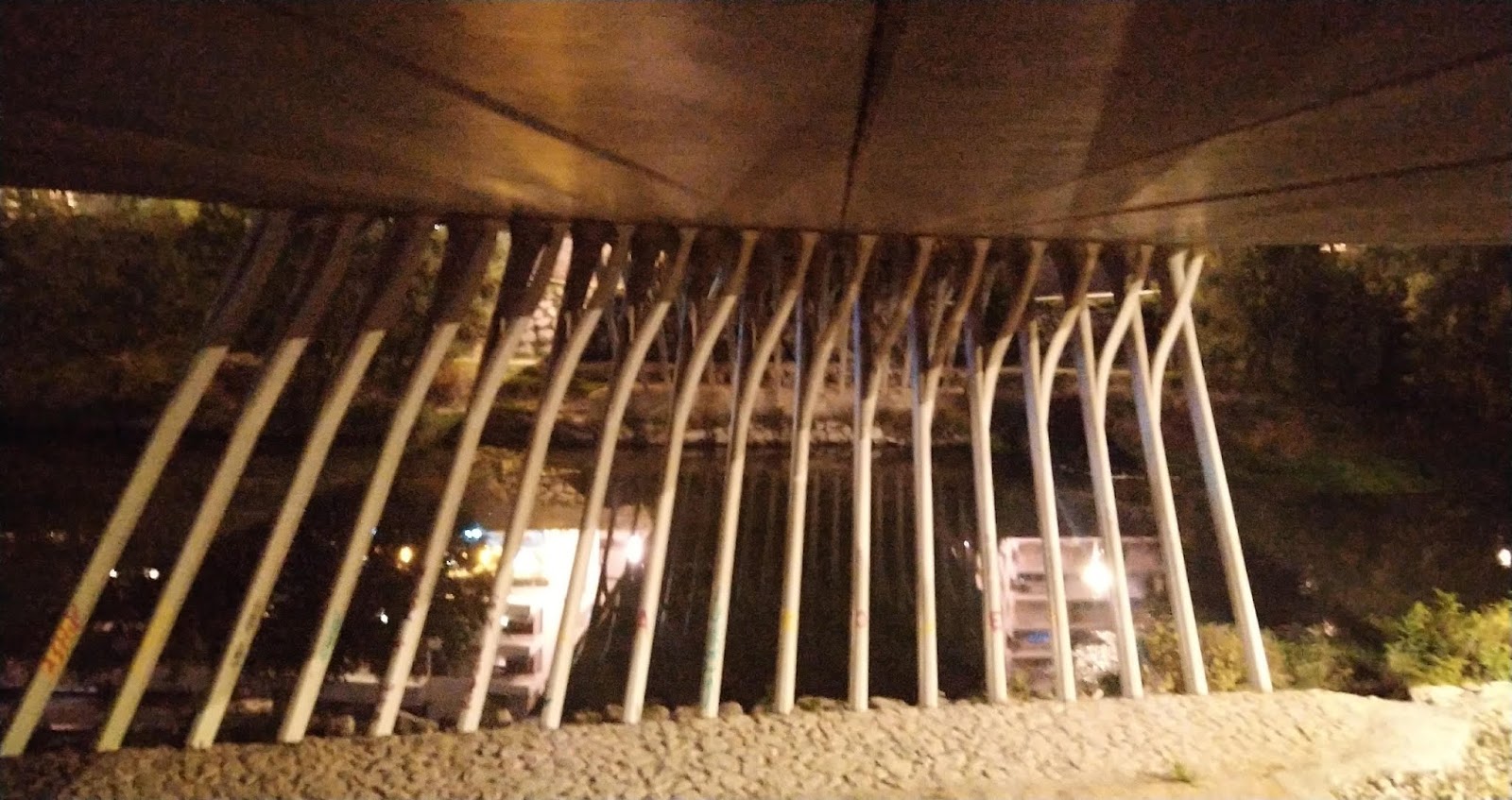
Another structure, interesting from architectural point of view, is bridge in Montpellier. These slender and organic-like piers were possible thanks to BSI®


One more impressive use of BSI® is the roof of the toll collecting point of Millau viaduct.


And finally, a cherry on top, the magnificent Millau viaduct. After reading so much about it, finally I have had chance not only to see it... but to visit it! Guys from EIFFAGE were so nice to show us (Mariia, Antoine and myself) everything, describe how the maintenance and its planning takes place... We could enter and touch whatever we wanted, from the safety surveillance center, through the deck up to the top of the pylon! And, importantly, that's not 'any' bridge, but the tallest one in the world! Take a look at its beautifully curved line on the photo below. No, it was not taken from the drone ;)


Now, charged with good energy I am back in Lausanne. I really liked Paris and work at EIFFAGE, but guess it's true what they say:

We can’t really appreciate home until we leave it

Bye, until next time!

Friday, 26 July 2019

My secondment at EIFFAGE


Hello everyone,

As I have mentioned in my last post, currently I am living in Paris!

I have moved here for three months to join EIFFAGE for my secondment within INFRASTAR project.

In here, I am working on new high speed railway connection in England - HS2.
My task is to optimize structures originally designed with concrete and steel by use of UHPFRC. In this way, we can save money, time, raw materials... and build the railway line from 21st century.

This is a great opportunity to see how the UHPFRC market looks like in reality and face problems that might be encountered while applying this novel material.

And, of course, to spend some time around the beautiful Eiffel tower ;)

Wish me luck!

Friday, 19 July 2019

The busiest period of doctorate(?)

Hello everyone,
As you can see, I didn't update this blog for some time... due to lack of time.

I am currently in mid-way of my PhD, 2.5 years past and 1.5 years left (among which 6 months will be still within the INFRASTAR project). This means that a) my experimental campaign is running at full speed, and b) I am starting to have first valuable results from both laboratory tests of R-UHPFRC and field monitoring of bridges.

Thus, I should be in multiple places at the time... To show you briefly how it looks like in practice, here is a brief overview of my agenda:

-6 weeks ago today, I have been in USA, where I was presenting first results of my experimental campaign on the conference UHPC 2019
-5 weeks ago, I have been working on the preparation of the journal paper about monitoring of Chillon viaduct
-4 weeks ago, I've been in the lab, preparing the static test of one of my beams (with use of fibre optics and DIC)
-3 weeks ago the INFRASTAR implementation day took place, thus I was visiting Copenhagen
-2 weeks ago, I've been preparing another static test in the lab
-a week ago, I've been working in the lab on the fatigue test
-and right now, I am on the train from Paris (where I have just started my secondment at EIFFAGE, more news soon) to Lausanne, to take care of my fatigue test and some personal stuff...

And, this shall continue more-less until the end of this year.

The good thing is that everything is rolling, so next year I hope to be more free in terms of affairs and able to work exclusively on the results of the fatigue tests.

That's it for now, stay tuned!

Friday, 26 April 2019

Fatigue exists. It really does.


Hello everyone, long time no read.

I’d like to share with you a story on my fatigue tests. As you know, fatigue of R-UHPFC beams is the main topic of my research (if you don’t remember what this abbreviation stands for, check my previous posts!)

Do you remember that I was doing some tests in cooperation with Antoine? The first beam instrumented with his Fibre Optics we've tested back in December under quasi-static loading. This was done mostly to calibrate the future fatigue load levels.

Then, the fatigue test followed. We have started it just before Christmas (in fact, we started to run it a day before Antoine left for his holidays, and two days before I have left for mine). The plan was to run it for some three to four weeks continuously. Thanks to internet, we were controlling everything in the lab in Lausanne, while he was in Lebanon and me in Poland. That’s the real globalisation!

But, on December 27th, the localized crack under the force application point has passed through one of the fibres in the upper flange. We've become ‘blind’ from this section on. Thus, we have had to temporarily stop the test. In mid-January, when both of us were back in Lausanne, we have re-connected and re-calibrated the fibre. The test continued.

In the beginning of February, strange thing happened. The jack could not produce anymore the force we wanted. Thus, we had to remove it without touching the sensors, not to de-calibrate them. That was like a surgery on an open heart, but our technicians are experts.

The jack was sent to the company for check-up. The reason of failure was… fatigue of one of the elements inside of the piston! After reparation, which took some 3 weeks, and re-installation on the testing rig (another week of work), in the beginning of March we have picked up the test. But, after just 2 days, the jack failed again! Unfortunately, during reparation, they have made a small mistake in the assembly. This meant another month of delay for me…

Finally, in the first days of April, the jack was installed again and the test continued. After another 2 weeks, on the 15th of April, circa 8AM, the beam failed! And so, after almost 4 months and 6.5 million of cycles, we have finished the test. It took some 3 months longer than planned!
I am writing this to show that the research is not only a success story. There are many things that can go wrong. Some of them depend on us; on some we don’t have any influence. Of course, it’s us who decide how to deal with the problems… and how to manage the time not to waste it! And, trust me, during these 4 months I’ve had plenty of other topics to work on ;).
Back in 2017, when I was starting my research, one of the experts has told me: ‘the fatigue experiments are very… fatiguing’. Believe me, he was right.

Thursday, 3 January 2019

Co-operation in cooperation

Hello everyone!

As you know, thanks to INFRASTAR we can travel to the partner institutions and work there with fellow Early Stage Researchers. Now at EPFL we have a visitor from France - Antoine. He's working on crack opening measurements using distributed fibre optics strain gauges. He got some nice results with ordinary concrete, thus we have decided to put them into my beams.

We've started the preparation of common experiment in September, when he came to Lausanne to glue some of his fibres on rebars, and to cast the beams with me. I must admit, that we have prepared a massive amount of sensors for some of the beams ;)


Then, when he came to EPFL for his secondment, we've glued some more fibres onto the surface of the beams.


Some of the beams prepared in this way will be tested in static, while the others in fatigue.

Thanks to that, he'll check if his method works with UHPFRC, and I'll get more interesting data on my specimens.

So, it's a WIN-WIN situation - that's how the cooperation should look like!


Sunday, 2 December 2018

Fatigue does exist!

Hello everyone,
today just a short post as lately I am very busy in the lab.

The first proper fatigue test is running. I am still amazed with the capabilities of our machines - in the current test I load and unload my beam 5 times per second with equivalent of 16 tonnes! Still, almost 3 weeks is needed to get 10 millions of cycles. You can see the beam during the test below.


In the meantime I have proven that the fatigue does exist (do you remember this?). Here is one of the bolts from my testing rig.


After strengthening of the connection the test continued.

That's it for now, I will keep you up to date!


Sunday, 11 November 2018

Experimental campaign... finally!

Hello everyone!

Long time no hear, as I am stuck in the lab. After casting, it is time to break some beams!

So far, I have tested three beams statically. I did it to get their resistance, which will help in calibration of my fatigue tests. One of the tested R-UHPFRC beams below, with visible huge force-redistribution steel beam on top of it.


I've got one unexpected shear failure... Which opened a whole new research branch on influence of vibrations during casting on the fibre orientation in beam! The project is ongoing.


And, when I say I BREAK the beams, I really mean it. The one below is broken for sure ;)

Thanks to its fibres, the UHPFRC is very ductile. Here, you can see a time-lapse video of the post-peak load. This means, that the beam has already reached its maximum resistance and now can be considered as damaged, but there is still a lot of capability of deflection and load support. 
Just imagine, that you can see through the beam while there is still a load of around 25 tonnes on it! (so, weight of 15 cars...) 


Stay tuned to see more pictures from another tests! Coming when I'll only find some time to upload them...


Thursday, 9 August 2018

Casting campaign

Hello everyone!

In the last post I was informing you about preparation of the casting campaign.
Now, my own small factory is fully operational, including:


Mixing,


casting... with use of external vibrators!


curing for 7 days in formworks,


demoulding, labeling,


...and finally moving to the storage area.

In July I have reached efficiency of  3 beams per week, which is a good result.

Unfortunately, I am not that good in taking videos with my cell phone... or maybe this post was just optimised for your mobiles? ;)

Now, the beams are awaiting for my test setup to be ready. This should happen within a week or two.
So, stay tuned!

Saturday, 2 June 2018

Step by step towards experimental campaign

Hello everyone!

One important part of my PhD research within INFRASTAR is an experimental campaign on R-UHPFRC beams (Reinforced Ultra High Performance Fibre Reinforced Cementitious composite).

This complex name stands for combination of UHPFRC and reinforcement bars, as known from reinforced concrete. I will not spoil the fun and reveal all the details for now - wait for it ;)

Currently I am getting step by step closer to the experiments themselves. But, there is a long way behind me already.

The origin of campaign takes back to the end of last year, when I was getting ready for my candidacy exam (read here) and I had to come up with ideas. I have decided to look at the problem of steel reinforcement and UHPFRC long term behaviour. This topic is relevant, as more and more structures are built every year, and it largely still hasn't been explored.

Since the beginning of 2018, fight for materials started. Finally, UHPFRC and reinforcement arrived to EPFL around May.


Then, there was time for material testing,

strain gauges gluing,

formwork preparation,

and the trial casting!

It even fitted the support that our technician fabricated for me!

For now, I have casted just the trial beam. But once I know the system works, I will start an extensive casting campaign this month! And, the first tests in July.

I will let you know!

Wednesday, 4 April 2018

Art of engineering

Hello everyone,

Lately, I've been taking part in 1st INFRASTAR implementation day (more info here). It was held by BASt (Federal Highway Research Institute) near Cologne, Germany.

Once there, I took a chance to walk the city and its riverbank. They have couple of road and railway bridges over there. This brought some thoughts to my mind.

According to the European codes, the design service life of a bridge is around 100 years. During that time, the traffic and the demands that we, a society, impose on a structure can change considerably. Just think of how the road traffic changed between 1918 and now!

One of the common cases, especially in case of bridges within the city limits, is need of widening of a bridge to accommodate higher number of cars, trains etc. But, this must be done not only under economical, but also under architectural constraints.

One of ways to widen the bridge is to add new, parallel structure. This strategy was used in two cases in Cologne.

In case of the railway bridge, a new structure was built next to existing one. Same material (steel) and type of structure was used, so that it is difficult to say the difference from the distance. But, closer look, reveals the progress that happened in civil engineering during the time.


Another case is a road-pedestrian bridge. Here, two different material were used (concrete and steel) but, to keep the nice look and compatibility, the box-girders were formed in similar way.

These two cases show, that an engineer needs to think of aesthetics, as well!

Wednesday, 7 February 2018

My education at EPFL


Hello everyone,

I have just finished the last courses within the EPFL ENAC doctoral school, thus I’d like to tell you how it works in here.

During the doctoral studies, which last for four years, the candidate is obliged to obtain 12 ECTS (European Credit Transfer System) points. One ECTS is equal to 25-30 hours of work, so 12 ECTS can be understood as 8.5 working weeks - seems easy.

During the first year (so before the candidacy exam that I have passed in December) at least 4 credits need to be obtained, and one of the core courses has to be passed. The core courses are meant to be universal, applicable for researchers of various specialisations and teach how to conduct the good research, analyse the data etc.

The 4 credits per year does not seem to be much. But I have noticed, and this is my personal view, that the difficulty of obtaining the points varies from university to university. In here, it is particularly difficult. In fact, if you want to transfer the points for the courses you’ve been attending somewhere else, you obtain less credits than people in the other places! This happened to me, when for the summer school at DTU I got 5 ECTS instead of 7.5, as all my other colleagues who took it with me did. All in all, getting 12 ECTS is harder than it seems.

The first year at EPFL is sometimes treated as a preparatory year. During this time the PhD candidate should deepen the knowledge, prepare the research plan and present it during the candidacy exam. I have decided that during this preparatory year I’ll take all the necessary courses, so that I can profit from this knowledge. So far, I have passed the following:
·                     Introduction to digital signal processing using Matlab, applied to environmental sciences and civil engineering (2 ECTS) – for better analysis of signals obtained during monitoring of structures
·                     Design of experiments (4 ECTS, core course) – for optimal design of experimental campaign
·                     Fracture Mechanics and Fatigue of Structures (2 ECTS) – for better understanding of fatigue phenomena
·                     New Concretes for Structures (2 ECTS) – for better understanding of UHPFRC
·                     Uncertainty and Sensitivity Analysis of Numerical Models (Summer school at DTU, 5 ECTS according to ENAC) – for producing better models of concrete and UHPFRC in fatigue, including stochastic models
·                     Two INFRASTAR training weeks (1 ECTS each) – to get the overall view of fatigue problem. The third one is scheduled for June 2018

So, in total I have obtained 17 ECTS, more than enough during the doctoral studies. Thanks to that, and being supported by the knowledge I have gathered, for the next three years I can focus on the research only!

I will keep you updated during that time.

Stay tuned!

Friday, 5 January 2018

The new year!

Hello everyone

I have really started my adventure with INFRASTAR and EPFL almost exactly one year ago.

2017 was extremely fruitful to me, including the new knowledge that I have gathered.

Especially the last weeks of the year were quite busy. At EPFL the first year of PhD is to some extend preparatory. It is the time to get into the field of works and prepare the schedule for the rest of the four years PhD program. After the first year, the candidacy exam takes place.

Mine happened on 21.12.2017, so just before the Christmas break.
I had to present my achievements so far, and the detailed research plan and schedule to the jury. Then, some difficult questions about the scientific background followed.
The exam itself is quite similar to the PhD private defense, except that no experts from outside of EPFL are invited. It is to check not only the planning and knowledge, but also the "soft" skills, so how do the candidate react on difficult questions, how he or she formulates the answers etc.

After the successfully passed exam and the whole year of hard work, I went for my Christmas holidays.

Since we are still in the very beginning of the new year, I wish to everyone the very happy 2018!

Best,
Bartek

Monday, 27 November 2017

Training week #2 at EPFL

Salut everyone!

Last week we have had the second Training Week within Infrastar. It took place at EPFL this time.

This was a great chance to talk to other ESRs and to open new fields of cooperation.

With Antoine I will be working on using his fibre optics in reinforced UHPFRC beams.

With Morteza we'll focus on planning the optimal campaign for short-therm monitoring of structures. The poster on this topic will be presented by ourselves during first Implementation Day at BASt symposium in Cologne, DE (more info here).

After the training week, full of new knowledge and ideas I am going back to work.

Stay tuned!


Thursday, 28 September 2017

Back to Lausanne

Time flies!

This is the end of my secondment in Aalborg.

During the stay, I have been working hard on probabilistic fatigue model of ordinary concrete in compression. My work will be useful (hopefully!) for guys from WP3 of Infrastar to calculate reliability of structures.

Aalborg is seeing me off with much worse weather then when I came here, so guess it is time to go back to Switzerland.

Tak Danmarg og vi ses!

Thursday, 17 August 2017

Secondment in Denmark

Hello Everyone!

Currently I am at Aalborg University of Technology in Denmark for my secondment.
I will work together with Joey Sima and Amol, and Gianluca will join us soon during his secondment at COWI.


Here, I will work on stochastic model for ordinary conrete in fatigue. That is why I started from taking part in summer school at DTU.


Stay tuned for more news!

End of the year, end of the PhD

 Hello everyone, I didn't write for quite some time - and it has been a busy time. Since my last post, I have managed to:  submit the do...